
by Helen D. Johnson
The power of our partnerships matter. When we lock arms with other people or organizations, we should understand that strong and powerful partnerships require healthy perspectives, a shared willingness to work hard to maximize impact, as well as clear shared goals. Perhaps, more importantly, there are no complex challenges that can be solved by a single entity, organization, or individual. Solving twenty-first century challenges is a cross-sector sport and requires collaboration and partnership.
Collaboration is a heavy lift. Like any heavy lifting, it requires practice and commitment. There’s no doubt that this makes it challenging and sometimes just plain messy. I wanted to share a few thoughts on partnership, along with some examples of some recent successful partnerships that the Michigan Municipal League and MML Foundation have learned from and been proud to be a part of, particularly in the area of local economic development.
It is important to start with articulating shared goals. We work with Michigan communities in many ways, and I’ll focus here on our work to build resilient, supportive frameworks for local leaders as they develop and sustain equitable local economies. For our funding partners in this work, we found that they shared our interest in local economic development, particularly in communities that had largely been left out of the more ‘urban-focused’ conversation.
COVID pulled back the curtain on the profound economic challenges for microbusinesses, particularly for entrepreneurs of color, women, and immigrant entrepreneurs who already struggled to access the support needed for recovery and growth. The pandemic deeply affected every community across the globe. In Michigan, we saw that it exposed how existing policies and resources often left underserved businesses behind and threatened the economic vitality and vibrancy of communities across urban, suburban, and rural areas.
Recognizing these challenges, the League and the MML Foundation partnered with the State of Michigan to administer $10 million in Pure Michigan Small Business Relief , to small businesses across the state, funded through the CARES act. These grants offered up to $15,000 for small businesses and provided critical relief.
But, with the 4000+ applications received, it quickly became clear that the true need far exceeded the available funding that went to almost 700 small businesses.
My colleagues and I understood that without additional resources and strategic support, many communities would struggle to sustain basic services or keep their small businesses afloat. These businesses were and are key engines of local economic vitality. To address this, we forged a partnership with the Ralph C. Wilson, Jr. Foundation to foster efforts focused on building resilient, supportive infrastructure to develop and sustain equitable local economies.
Over the past four years, the League and MML Foundation have continued to build and develop our partnership with Wilson Foundation to support community-led efforts aimed at strengthening local economies. We have worked intensively with nine communities, particularly in rural and out county areas in Southeast Michigan, to develop cross-sector stakeholder meetings and tailor tools and strategies that enhance their small business and entrepreneurship ecosystems. This work has served as a testing ground, allowing us to learn directly from practitioners and adapt solutions to diverse community contexts.
During this time, we also began a partnership with the DTE Foundation to offer microgrants to and city leaders to develop efforts that would build bridges across community divides and bring people together in creative and innovative ways. After 50 successful Bridge Builders grants, we worked with the DTE Foundation to transition the funding to microgrants that support place-based economic development and offer seed funding for projects that leverage creativity and innovation to drive positive outcomes for micro and small businesses.
These partnerships have produced learning that we believe is shareable and scalable. This includes detailed Opportunity Reports for individual communities and two adaptive tools, the Microbusiness Essentials Guide and the Comprehensive Playbook, both offering clear strategies and policies to foster a thriving local business environment. To accelerate impact, we supplemented these resources with microgrants and site-specific technical assistance, ensuring that communities could seed and launch sustainable solutions immediately.
This work highlights the significance of cross-sector collaboration. It is essential in partnerships aimed at community initiatives that aim to support a thriving community.

Listen with intentionality. It is critical to understand the diverse perspectives of all partners. In our community work, we have created a framework to dive into the perspectives of cross-sector groups of stakeholders in the community. To map the opportunities and the issues, we need to understand the needs of a diverse group of entrepreneurs. These conversations start to create a map of the resources that exist for entrepreneurs. This inquiry kicks off the opportunity for partners to dream together what an even stronger entrepreneurial landscape could and should look like.
The success of the local economies effort is also because we have deep partnerships with the incredible communities we have been working with. Just recently, we held a convening in the City of Farmington where we brought together five of our community partners, as well as some of our business, nonprofit and philanthropic partners who are engaged in the work.
Community representatives presented and shared their issues and opportunities with each other. There were questions asked, and accolades shared, wonderful walking tours around downtown Farmington, and warm hospitality offered by Mayor Joe LaRussa and the hosting restaurant, John Cowley & Sons.
I wasn’t the only one who left the convening walking a little straighter and feeling a little more hopeful. There is real progress happening in Michigan communities. Stories of innovative, adaptive reuse in Monroe, activating an unused parcel in downtown Utica as a new pocket park, placemaking in Ortonville, and showcasing community assets in Bellville – these stories sparked ideas in other communities and raised awareness across the board that more people need to hear about what’s happening because communities are leveraging their assets, working with partners and paying attention to making tangible improvements.
The storytelling aspect of this also can’t be understated. We were grateful to the design firm CRIMSON for pointing out the importance of clear and cohesive storytelling. When there are partners working together, many times the piece that gets forgotten is coordinated messaging about the impacts and outcomes of an effort or initiative. Design and narrative development shouldn’t be an afterthought. They should be primary components of an effort. And good design matters.
We live in a noisy world. There are a million things a day that are vying for our attention. So, when something special is happening that the community needs to know and pay attention to it’s going to require some intentionality and expertise in communications to attract attention to the project. Crimson shared that a brand is an expression of a shared system of beliefs and values that define an organization and attach others to it, through cohesive and consistent ingredients, including clear purpose/mission, messaging, not surprisingly, logo, fonts and color. There is also a need to point out what differentiates this effort from whatever else is trying to grab the attention of your intended audience and that requires you to be thoughtful about your tone and the stories you share.
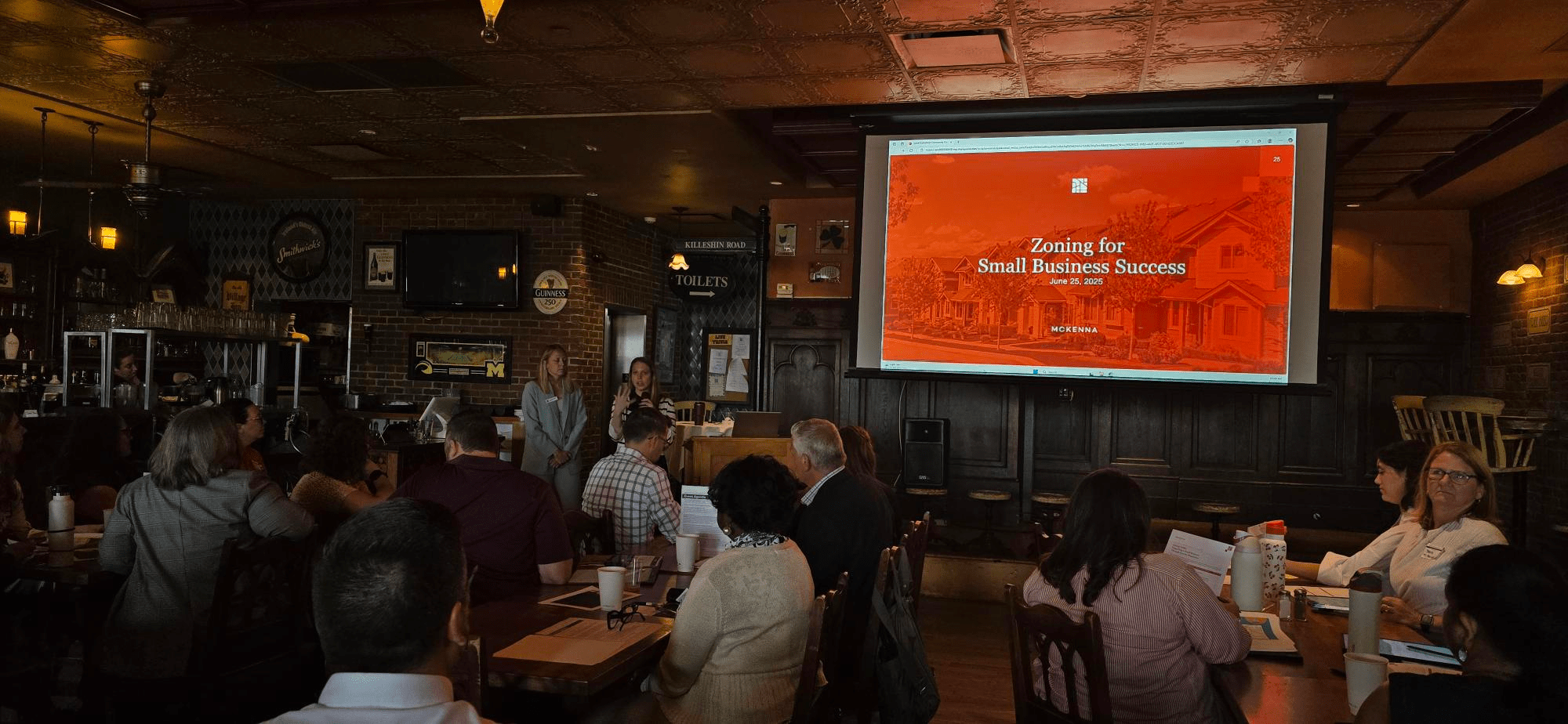

A thriving local economy takes work and diverse partnerships from community residents, businesses, nonprofits, business service providers, philanthropy and a raft of experts who can highlight issues and opportunities.
On the note of experts, our team has been thankful to work with the smart folks at McKenna. McKenna urged participants to consider how powerful zoning amendments can be to support small business success. They shared that reducing the friction that sometimes happens when businesses try to re-occupy a vacant storefront can help them get up and running faster. When that process is unclear, or worse, lags, small businesses can burn through precious resources and end up not having the flexibility or funding to make the space work when it finally is ready. McKenna covered a range of topics that city leaders need to integrate into their portfolio of resources, including tips on promoting mixed-use development, how to support home-based businesses and what kinds of guides and inter-departmental coordination might benefit and feed a thriving local economy.
This work continues to highlight how important it is to engage diverse groups of partners/experts and build lasting partnerships that empower communities to recover and grow in the face of real challenges. It also underscores the importance of collaborative leadership in creating resilient and equitable local economies that serve all residents.
Michigan has experienced tremendous economic growth and expansion with small businesses starting and creating jobs at record levels. Michigan’s small businesses, particularly those with 10 or fewer employees, are the backbone of our state’s economy. We must do everything in our power to support this vital sector and those associated with it. It benefits all of us on both a local and a state level.